
Irmgard Emmelhainz is an independent writer and researcher based in Mexico City. In 2012, she published a collection of essays about art, culture, cinema and geopolitics: Alotropías en la trinchera evanescente: estética y geopolítica en la era de la guerra total (BUAP). Her work about cinema, the Palestine Question, art, culture and neoliberalism has been translated to French, English, Arabic, Turkish, Hebrew and Serbian. She is currently co-editing an issue dedicated to Mexico City of Scapegoat Journal, and teaching a course at the Esmeralda National School of Engraving and Painting in Mexico City.
Jean-Luc Godard’s Ici et ailleurs (1969-1974) as well as Chris Marker’s Le fond de l’air est rouge (1977) crystallize the histories of militant engagement and political filmmaking in the 1960s, a time in which Marxism was a vehicle for cultural as well as actual revolution here and elsewhere. From both films, lessons about this era of militantism can be drawn. Moreover, they announce a turn in the 1970s and 1980s toward minority politics (tied to de-colonization struggles) and humanitarization –which implies an ethical, as opposed to political relationship to the elsewhere, as well as the utopia of globalization. Bearing this in mind, Irmgard Emmelhainz will discuss the changes in the meaning of ‘politicization’ and political work from the 1960s from what is known today as ‘Sensible Politics’: a form of politicization active at the level of encoding unstable political acts in medial forms. Taking up Jean-Luc Godard’s plea for texts and poetry (inspired by Aristotle’s and Hannah Arendt’s understanding of political action as speech), in his film Notre musique, she will argue that most of the current politicized images are compensatory devices to the ravages caused by neoliberal reforms implemented worldwide in the past two decades.
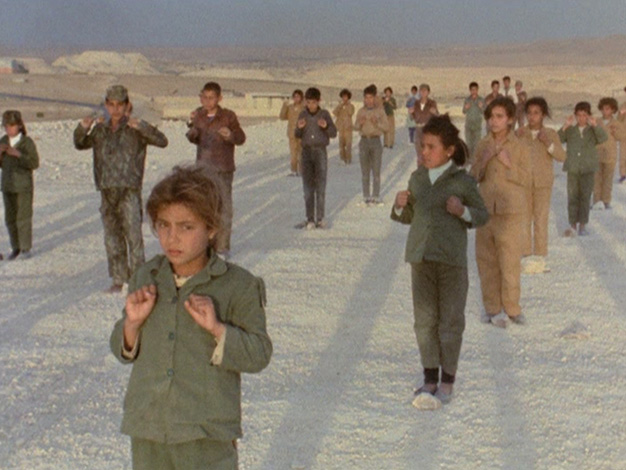
Here, an average family in front of their television. Elsewhere, Palestinian fighters, filmed during their daily activities, their training, their deaths. In 1974, Jean-Luc Godard en Anne-Marie Miéville presented a rereading of footage that was shot four years before in Lebanon, Syria and Jordan. As Gilles Deleuze wrote about Ici et ailleurs: “It is not a matter of following a chain of images, even across voids, but of getting out of the chain or the association. Film ceases to be 'images in a chain ... an uninterrupted chain of images each one the slave of the next', and whose slave we are. It is the method of BETWEEN, 'between two images', which does away with all cinema of the One.”
French spoken
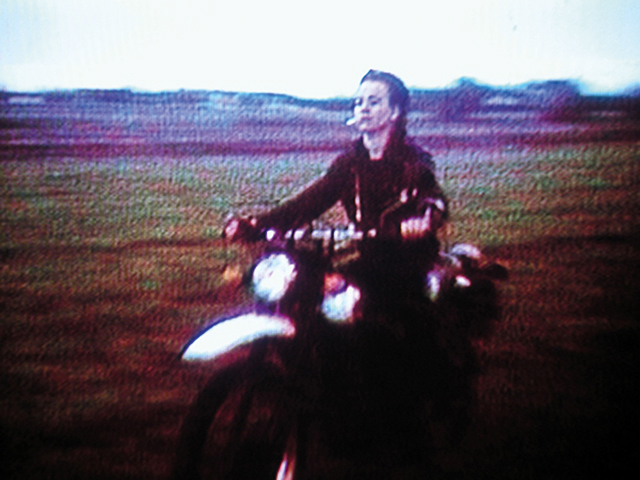
My best friend when I was 17, was a girl called Andrea Wolf. She died in 1998, when she was shot as a Kurdish terrorist in Eastern Anatolia... This project tackles the question of what is nowadays called terrorism and used to be called internationalism once. It deals with the gestures and postures it can create, and their relationship to figures of popular culture, namely cinema. Its point of departure is a feminist martial arts film Andrea Wolf and I made together when we were 17 years old. Now this fictional martial arts flick has suddenly become a document. November is not a documentary about Andrea Wolf. It is not a film about the situation in Kurdistan. It deals with the gestures of liberation after the end of history, as reflected through popular culture and travelling images. This project is a film about the era of November, when revolution seems to be over and only its gestures keep circulating. (HS)


