
This program compiles a number of Bruce Baillie’s poetic and social documentaries created for Canyon Cinema venues, entitled The News. These little films provided a format for creating low-budget, urgent, and politically motivated works. They also demonstrated possibilities for a more immediate transition from production to exhibition.
Introduced by Garbiñe Ortega.
This program is also shown on October 8 at 18h00.

A very brief lyrical portrait of the eponymous Japanese gardener at work.
“A living saint projected onto the silver screen. Why did I make this film? I wanted to help my friend find a job in Berkeley. It was one of my first attempts to create film as both utilitarian and Art. Cinema must be meaningful and wonderful in a single stroke of camera and mind. Mr. Hayashi was my own, simple example, derived from an experience in a Zagreb city well, where water and daily gossip flowed freely.” – B.B.
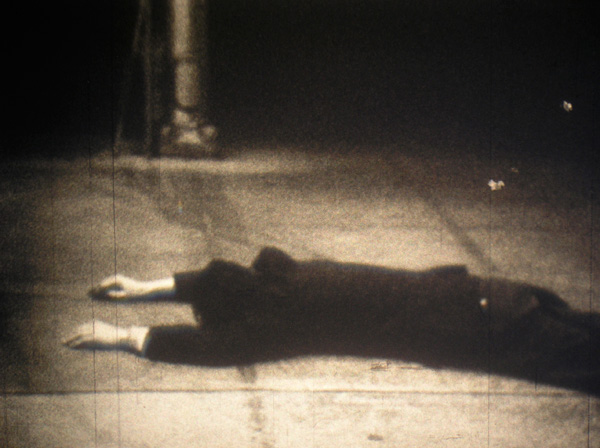
A film mass, for the Dakota Sioux. The Ordinary Mass is traditionally a celebration of Life; thus perhaps there is a contradiction between the form of the Mass and the theme of death in any Requiem Mass (Mozart, etc.). The dedication is to the (religious) nation destroyed by a civilization that evolved from the Mass. Created during the winter of 1963-64, between Berkeley and Mendocino, after a trip into North and South Dakota, down through the junction of New Mexico, Colorado, Utah, and Arizona, and back to the West Coast. The heroic aspect of this work is part of a personal chain of discovery for the author, including To Parsifal, Quixote, and Quick Billy.
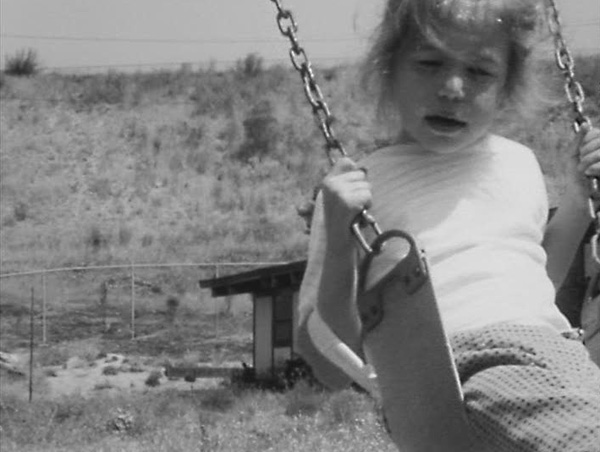
“A film for the East Bay Activity Center in Oakland, a school for mentally disturbed children.” – B.B.
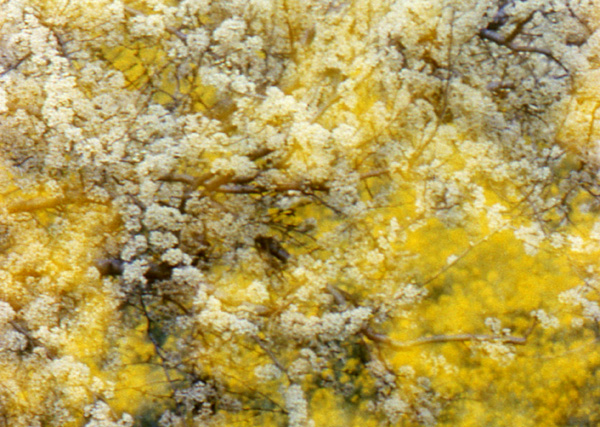
In three sections with three different formal strategies, Baillie shares distilled moments of found natural beauty as he encountered them in the North Bay outside San Francisco. The first section features a study of plum blossoms, rendered in rich, multiple superimpositions that allow the white flowers to explode into a blizzard of visual complexity, framed by a panning shot of purple mountains. In the second section, Baillie allows us a furtive glimpse of the titular little girl, waving to cars with her dog on the side of the road, lost in her world and thoughts. Bruce’s framing remains unadorned, feeling no need to add to or take away from a beautiful piece of simple portraiture. The third section, of waterbugs on the surface of a pond, reminds us how remarkable and sensitive Baillie’s camerawork can be, as he observes their graceful dances, and the subtle light and water effects they produce by their movements. (Mark Toscano)


