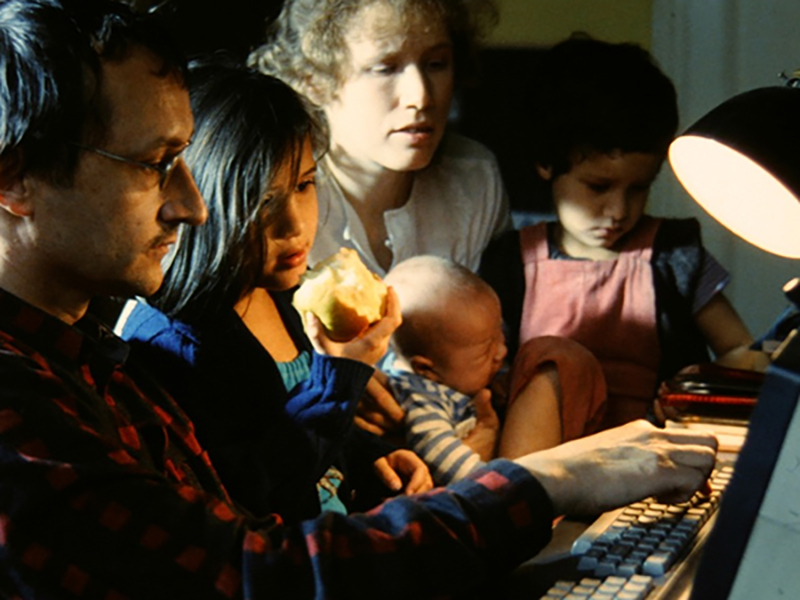
"Alexander Kluge's films comprise some of the most thought-provoking, original works to come out of the New German Cinema. He is noted for his use of complex narrative structure, innovatively combining disparate elements. In Der Angriff der Gegenwart auf die übrige Zeit (The Assault of the Present Upon the Rest of Time), Kluge continues his fascination with history, culture and cinema as he examines the close of the twentieth century. Opening with a production of Verdi's Tosca, he sets up a contrast between the treatment of moral and aesthetic issues in the nineteenth century, and their examination in the cinema. Several stories are juxtaposed, creating a filmic essay, a montage of ideas and reflections on a present which affects our perceptions of both the past and the future. At the center, serving perhaps as a metaphor both for his film and for cinema, is the story of a director who goes blind while working on his latest film. He continues working, his head full of images, trying to create what he cannot see." (Kathy Geritz)
“We speak about the opera of the 19th century; it is considered the summit of dramatic art. In the film Die Mach der Gefühle (The Power of Emotion), opera was likened to a "power plant of emotions." The film Carmen by Carlos Saura has shown that such older forms of dramatic art tap certain currents in spectators; this is something we did not know before. Bound up with our own century is another "power plant of emotions" - the cinema. Presumably, in the next century, beginning sixteen years from now, we will call it the cinema of the 20th century. This art form is ninety years old - a love affair of the century. The cinema consists of screening rooms, movie palaces, theaters on the front-lines, as well as many other gathering places, wherever films are shown for money. It also consists of a series of fascinating technical inventions which, though very elementary compared with the capabilities of electronics, all have to do with with the construction of a time machine. This cinema tells stories and it has produced artistic figures [Kunstfiguren] and idols. Obviously, this medium intrigues me. The present film project deals
(1) with elements of cinema;
(2) with the illusion of the city;
(3) with people acting in the city who have all kinds of things moving through their heads: personal experiences, notions about cinema, the reality of the city.
The stylistic link, and simultaneously the basis for a certain comic dimension corresponding to the seriousness of the situation, is the category of time. Cinematic time, the "condensed dramatic time of cities," a lifetime - wrestling with time obviously occupies the course of our lives.”
Alexander Kluge, Der Angriff der Gegenwart auf die übrige Zeit (Frankfurt am Main: Syndikat Autoren und Verlagsgesellschaft, 1985)


