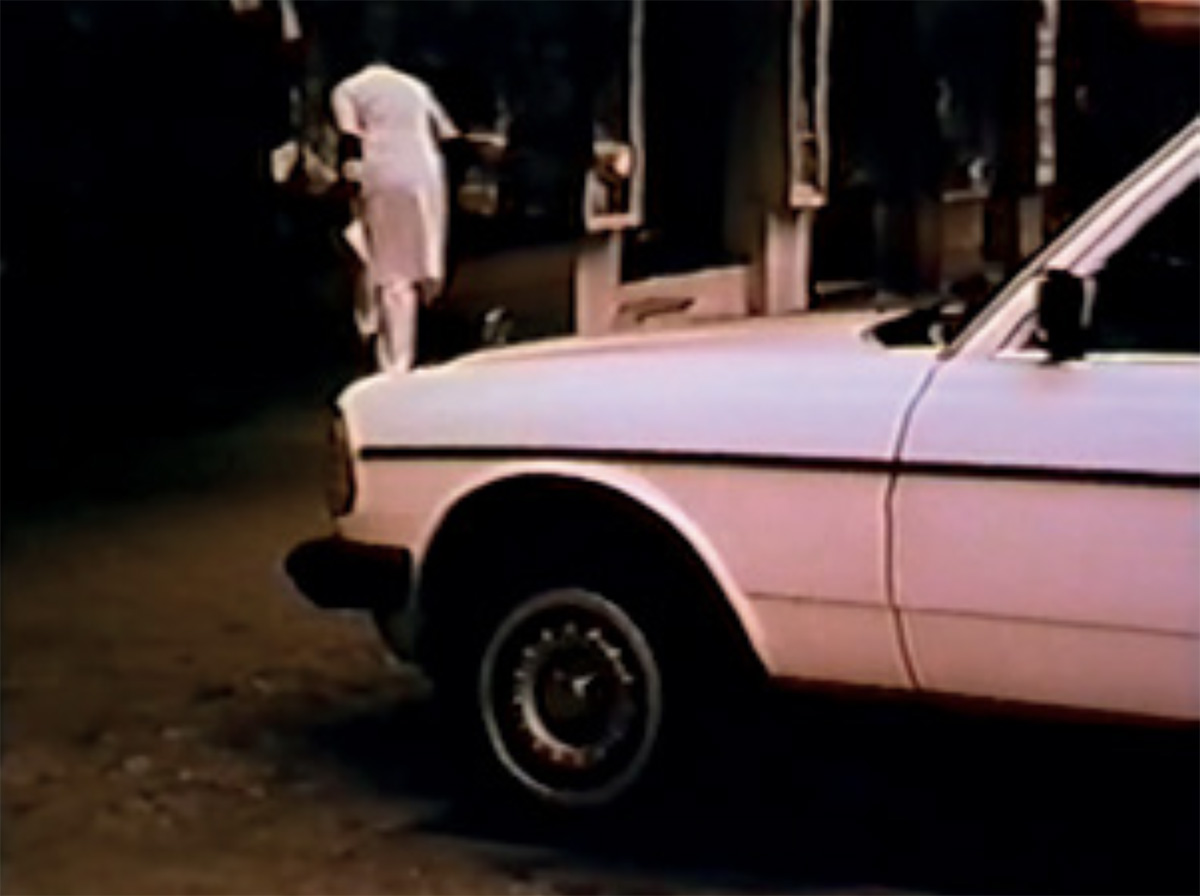
Ernie Gehr, the son of German Jewish émigrés, might have called Berlin home had fascism not tragically intervened. The film takes its title from the Wehrmacht propaganda magazine of the same name. Its opening shot is backgrounded by a cropped view of the magazine’s cover. The explicitness of this reference comes as somewhat of a feint, as Gehr’s approach to history is otherwise oblique. Signal unfolds in a site of little dramatic consequence: an anonymous intersection, somewhere, we glean from interspersed street signs, on the Rheinstraße. Creamsicle trash cans touting the slogan “Berlin...ICH MACHE MIT” (“Berlin...COUNT ME IN”), locate us in Germany’s capital. Yet Gehr withholds further orientation. The intersection’s nondescriptness repels attempts to impute significance. Gehr couples his crystal-like montage with segments clipped from a cheap German radio and street sounds that never quite align with what we see. Heels clack, buses stall, and conversations transpire over scenes emptied of all but asphalt and low-rises. The faint sound of ghostly and multilingual voices compounds our sense of dislocation. The soundtrack constantly points to an ethereal absence, not only emanating from other parts of the world, but also from Berlin’s continually haunting past. “Gehr films the streets as if they were the scene of a crime,” wrote J. Hoberman in his review of the film. Gehr edited Hoberman’s assessment: “there was,” he said, “no ‘as if’ about it.”
“Signal — Germany on the Air uses empty camera movements, anonymous citizens, and the ubiquitous radio to portray an absent subject, the filmmaker and survivor on a street in Berlin where he no longer lives. An alternative future, another world, opens in the space where I am not, where I might have been. Others are witness to my invisibility, to my absence in advance, and to my return to the place where I am not, or no longer am. The subject is spectral, a trace that marks an absence in advance: An absent, reflected subjectivity, invisible to the film, an autobiograph under erasure.“ (Akira Mizuta Lippit)


