
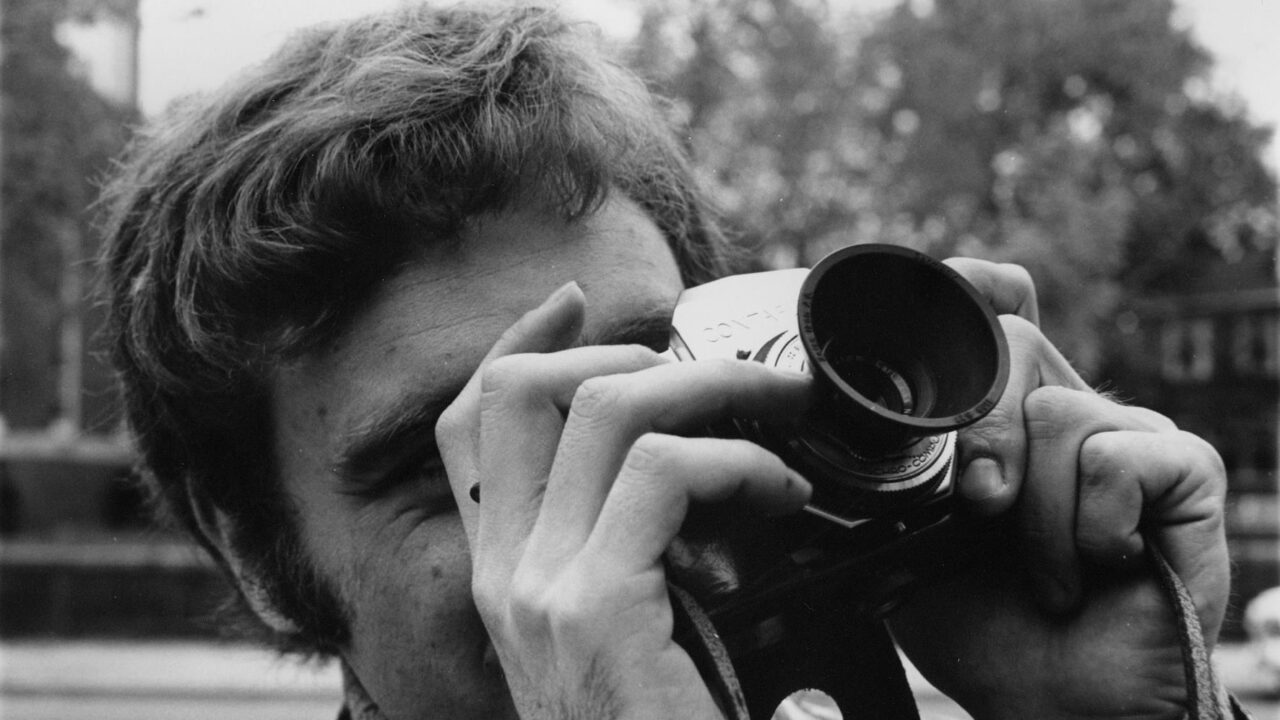
“While the first scene is lipsynched, all the rest of the dialogue is spoken by people outside the frame. It relates the comments of the two people watching the film. Nothing groundbreaking is said: it is mostly about recognition and memory - how it is said is important, not what is said”. (Morgan Fisher)

“Naturalness wilfully corrupted by inevitable self-consciousness, unwittingly corrupted by unavoidable naturalness, a role played with incredible nuance and complexity by Maurine Connor”. (Mark Toscano)

The phi phenomenon is a perceptual illusion (first described in 1912 by Max Wertheimer) in which a succession of still images produces a disembodied perception of motion. “Phi Phenomenon is astonishing precisely because its object is so familiar, and it fascinates me because it is a motion picture in which there is movement but no apparent movement.” (Thom Andersen)
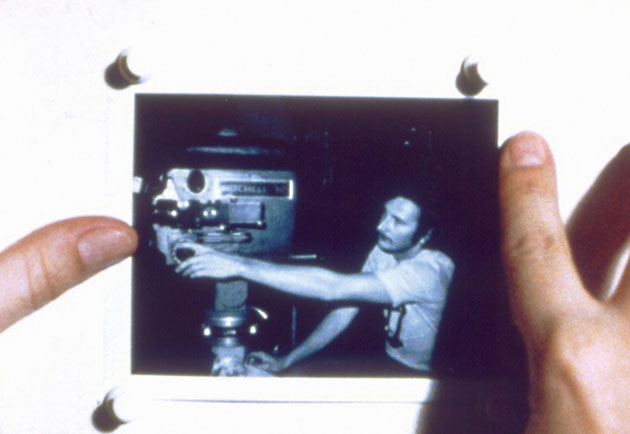
As its title indicates, the subject in this film is a series of production stills of a film that was never made, and that at the same time is the film we are watching. The image is one long take (11 minutes) of a wall on which a hand sequentially pins a number of Polaroids, one after the other. The Polaroids depict the crew making the film; the synchronous sound allows us to hear in ‘real time’, their chatter and the hum of the still camera, so that we can anticipate the photos and assign faces to the voices we hear.
“A documentary about nothing but itself; technicians become actors, equipment becomes props; the reality captured by the film exists only for the duration of the film. The soundtrack consists of the mumbling and talking of the crew during production. It is at no point lip-synched.” (Morgan Fisher)

Film school in 11 minutes. And a high water mark of cinematic self-reflexivity. Morgan gives us the four states of a film: picture with sound, picture with no sound, sound with no picture, and the null set. Reminiscent of David Fair’s advice on guitar: “It’s pretty easy to play guitar, once you know the science of it. The high notes, the little skinny ones, make high sounds. The big fat ones make low sounds. And then if you go on the part of the guitar near where you pluck it, that makes high sounds. And down at the other end. Like, then you got it mastered. That’s all you gotta know. Oh, and if you want it to be fast, play fast. And if you wanna go slow, go slow. That’s all there is to it. It’s easy to play guitar. Other people, some people worry about chords and stuff. Ya know, and that’s alright too. Ya know, there’s all kinds of music in the world. You might wanna learn some other stuff if you’re doing that kind of music. For what I was doing, that was the beauty of it; you could learn it that first day.” Get to work.
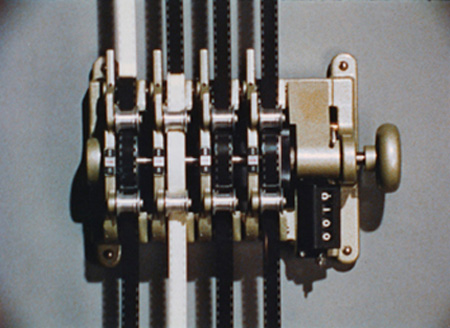
“Cue Rolls appears to be a continuous five-and-a-half- minute shot, the visual subject of which is a synchronizer through which four strands of black and white leader are running continuously. As the soundtrack makes clear, Fisher has applied what once was a standard industry practice (for making colour corrections and other modifications before final prints were struck) to a situation in which it would seem to be entirely irrelevant.” (Scott MacDonald)

“The projectionist is no longer the means for delivering the performances of actors to the audience; the projectionist is a performer who, at Fisher’s instruction (or, in a sense, at the film’s instruction) succinctly demonstrates (or fails to demonstrate) the various dimensions of the viewing experience controlled from the projection booth”. (Scott MacDonald)


